
Pakistan's Deputy Prime Minister Ishaq Dar stated that the Indus Waters Treaty remains valid and binding, rejecting India's decision to revoke it following a terror attack. He emphasised the treaty's role in regional peace and warned of "profound consequences" if Pakistan is deprived of its allocated waters. PPP chief Bilawal Bhutto Zardari also proposed an international convention against the weaponisation of waterways.
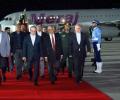
A new report alleges Pakistan shielded Iranian military aircraft from potential US airstrikes, raising questions about its role as a neutral mediator in the ongoing US-Iran tensions.

Pakistan has announced its commitment to continue facilitating talks between the United States and Iran, urging both nations to uphold the ceasefire agreement. Deputy Prime Minister Ishaq Dar highlighted Pakistan's role in mediating recent discussions and expressed hope for durable peace and regional stability.

India is navigating a complex diplomatic landscape, attempting to balance its 'forever honeymoon' with the Israel-UAE-Bahrain axis against its historical ties with Iran, as evidenced by recent high-level visits and evolving geopolitical realignments in the Middle East, observes Ambassador M K Bhadrakumar.

US Special Envoy Steve Witkoff and Iranian Foreign Minister Abbas Araghchi are reportedly heading to Switzerland for a new round of US-Iran negotiations, following a recently announced memorandum of understanding to end hostilities in West Asia and a ceasefire between Israel and Hezbollah.

West Bengal's Bharatiya Janata Party government has moved to institutionalise its "detect, delete and deport" policy by directing all district administrations to set up "holding centres" for suspected illegal foreigners and foreign prisoners awaiting repatriation -- a step that appeared to give administrative shape to one of the party's most potent political themes in the state.

A suspected operative of Pakistan-based terror outfit Jaish-e-Mohammed (JeM) was arrested in West Bengal's Purba Bardhaman district, and investigators believe he could be part of an ISI-backed network tasked with collecting intelligence on VIPs including BJP leaders, recruiting operatives and laying the groundwork for possible terror activities in the state.

Pakistan has conveyed to India at the diplomatic level that their foreign ministers should meet to discuss the ceasefire violations on the Line of Control that triggered tensions, a media report said on Tuesday. The suggestion for talks was initially made through the media by Pakistan Foreign Minister Hina Rabbani Khar to gauge the possible reaction from India. Subsequently, the message was taken up through diplomatic channels, The News quoted its sources as saying.

Pakistan has criticised India's recent remarks on Pakistan-occupied Kashmir (PoK) protests, asserting it is addressing issues democratically. Pakistan also warned India against blocking water, calling it an "act of war," and commented on India's nuclear capabilities and its own military strikes in Afghanistan.

'We caught General Pervez Musharraf talking over the phone with his Chief of General Staff Lieutenant General Mohammad Aziz. Musharraf was visiting China; Aziz was in Rawalpindi.'

Pakistan is set to host face-to-face talks between the United States and Iran, aiming to solidify a fragile ceasefire and prevent further conflict in West Asia. The discussions will focus on a long-term peace arrangement, including sanctions relief, regional security, and Iran's nuclear program.

Sonia Gandhi criticised PM Modi's Israel visit, calling it a "bewildering strategic decision" amid the regional conflict.
China has urged Pakistan and Afghanistan to engage in direct talks to resolve their ongoing conflict, offering to mediate and calling for a ceasefire.

Iran's Foreign Ministry has denied reports of planned talks with the United States during a visit to Islamabad, Pakistan, despite US envoys also visiting the region.

US President Donald Trump threatened to bomb Iran if a deal is not reached before the ceasefire ends, while Pakistan urged both sides to extend the truce and pursue diplomacy.

The US and Iranian delegations left Pakistan after failing to reach an agreement in historic talks aimed at resolving the West Asia conflict and stabilising global energy markets.

Pakistan capital Islamabad is emerging as the leading venue for the next round of technical negotiations between the US and Iran, a media report said Sunday.

Russian Foreign Minister Sergei Lavrov discussed tensions between Afghanistan and Pakistan with his Afghan counterpart, Amir Khan Mottaqi, following US-Israeli strikes on Iran, emphasising the need for political and diplomatic solutions.

Iran has reportedly allowed select "friendly nations" including India and Pakistan limited access to the Strait of Hormuz amid ongoing conflict, easing some energy supply concerns. Here's what the move means for global trade and oil routes.

US President Donald Trump has lauded a newly announced peace deal between the United States and Iran, predicting it will bring "peace and security" to West Asia and facilitate the reopening of the strategically vital Strait of Hormuz.

Iranian President Masoud Pezeshkian is on a state visit to Pakistan to discuss the full implementation of an agreement signed between Iran and the US, alongside regional and international developments. The visit also aims to strengthen bilateral cooperation across various sectors, following recent high-level talks between the US and Iran in Switzerland regarding regional security.

Doubts are emerging about Pakistan's role in mediating peace negotiations between the US and Iran, with suggestions that Islamabad's efforts are stalling and failing to secure a definitive response from the United States.

The harsh truth is that the US is no longer a reliable partner, cautions Ramesh Menon.

Delegations from the US and Iran have arrived in Islamabad for talks aimed at resolving the conflict between the two nations, following a ceasefire brokered by Pakistan. The negotiations are being closely watched due to their potential impact on regional security and global diplomacy.

Pakistan's Interior Minister Mohsin Naqvi visited Tehran for the third time recently to mediate peace amidst rising tensions between the US and Iran. Pakistan is actively leading diplomatic efforts to de-escalate the conflict in West Asia, which has impacted global energy markets and trade.

Pakistan's Interior Minister Mohsin Naqvi has been in Tehran meeting with Iranian officials in an attempt to mediate and resolve the ongoing conflict between the US and Iran. This marks Naqvi's second visit in less than a week as Pakistan seeks to bridge the differences between the two nations and establish long-term stability in the region.

The United States and Iran are scheduled to hold their initial round of talks in Switzerland on Friday, following a ceasefire agreement virtually signed by US President Donald Trump and Iranian President Masoud Pezeshkian.

Iranian Foreign Minister Seyed Abbas Araghchi spoke with Indian counterpart S Jaishankar to discuss the West Asia crisis, following discussions with Russian President Vladimir Putin.

China and Pakistan have jointly proposed a five-point peace plan to address the ongoing conflict in West Asia, focusing on de-escalation and safe passage through the Strait of Hormuz.

Pakistan is playing a key role in facilitating talks between the US and Iran, but the future of these negotiations remains uncertain. Despite ongoing diplomatic efforts, no dates have been set for a second round of discussions.

An Iranian delegation, led by Foreign Minister Abbas Araghchi, concluded high-level meetings in Islamabad, delivering an 'official list of demands' to Pakistani leaders for the US and Israel. This comes as President Trump cancelled his envoys' visit to Islamabad amid ongoing efforts to facilitate peace talks between Iran and the US.
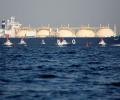
Iranian Deputy Foreign Minister Kazem Gharibabadi has urged India to take the lead in bringing peace to West Asia, highlighting the UAE's role in stalling BRICS consensus on the conflict. Gharibabadi also discussed a new framework with Oman for merchant vessels passing through the Strait of Hormuz.

Pakistan's Prime Minister Shehbaz Sharif has engaged in extensive diplomatic efforts to de-escalate the conflict in West Asia, offering to host talks between the US and Iran and engaging with leaders from Saudi Arabia, Qatar, Malaysia, the UK, China, and the European Union.

Iran's Deputy Foreign Minister Kazem Gharibabadi confirmed a peace deal with the United States, stating that Tehran will enter a 60-day negotiation period only after verifying Washington's commitments to ending hostilities, lifting the blockade, and releasing Iranian assets.

Officials from Pakistan, Afghanistan, and China are meeting in Urumqi to discuss regional security concerns and potential confidence-building measures.

'The flip side of this is that he won't hesitate to call out India if he thinks its policies are hurting US economic interests or border US foreign policy goals.'

The Vishva Hindu Parishad (VHP) has appealed to the United Nations to intervene on behalf of religious minorities in Pakistan and Bangladesh, citing human rights violations.

Former External Affairs Minister K Natwar Singh passed away on Saturday night after a prolonged illness, family sources said. He was 93.

US Secretary of State Marco Rubio arrived in Kolkata for a four-day diplomatic tour to India, marking the first visit by a US secretary of state to the city in 14 years. His itinerary includes meetings with Indian officials, energy talks, and a Quad Foreign Ministers Meeting.

US Secretary of State Marco Rubio will visit India for four days to strengthen bilateral relations, holding talks with Indian leaders and attending the Quad foreign ministers' meeting.
